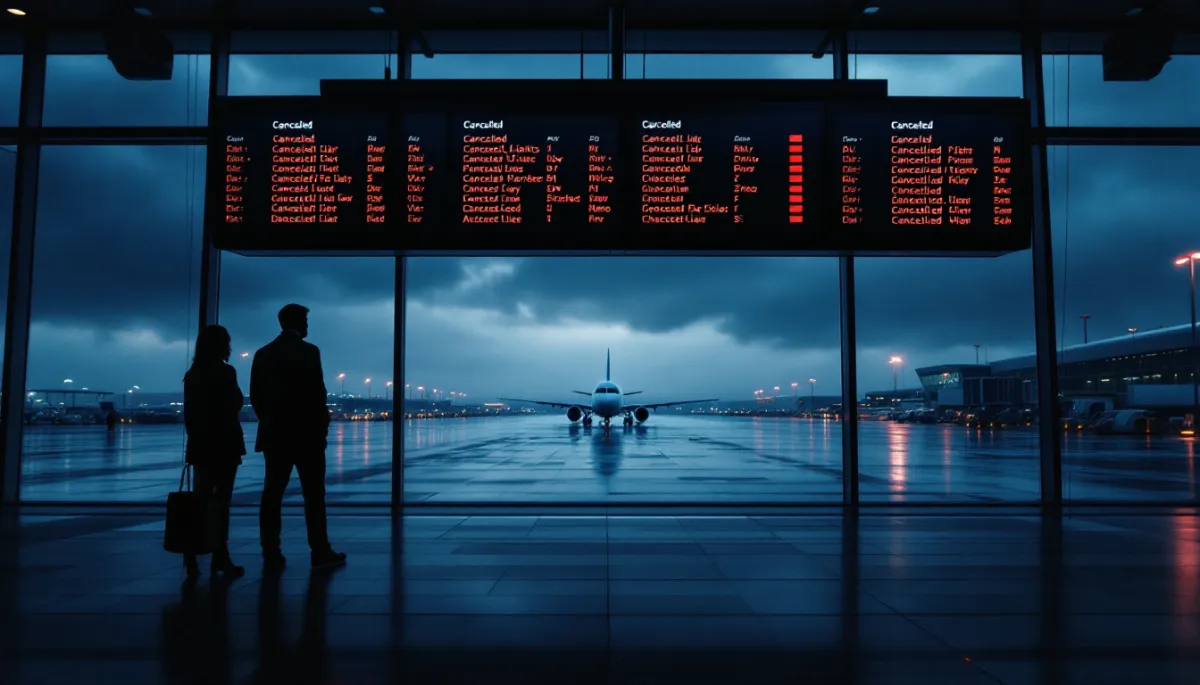
Europe's Jet Fuel Clock Just Ran Out: What Expats Must Know
Europe's jet fuel crisis is no longer a forecast. The International Energy Agency warned in mid-April that Europe had approximately six weeks of jet fuel remaining at then-current consumption rates. That window has now closed. Jet fuel in Europe is trading at $187 per barrel, double the price of a year ago. Lufthansa has cut 20,000 short-haul flights through October. ConocoPhillips has warned of systemic shortages in import-dependent markets by June and July. If you are an expat planning a European summer trip, holding airline equities, or employed in the travel sector, what happens in the next four to six weeks has direct financial consequences for you.
Last updated: 13 May 2026
Key Takeaways
- European jet fuel is at $187/barrel -- double a year ago -- and the IEA's six-week supply warning from mid-April has now expired, placing aviation at critical risk through June and July.
- Lufthansa has already cut 20,000 short-haul flights through October in response to supply constraints.
- Expats planning European summer travel face meaningful cancellation risk and price surges, particularly on routes through Dubai and Gulf hubs.
- Airline equities with heavy European exposure are among the highest-risk holdings in an expat portfolio right now.
How Did European Jet Fuel Get to $187 a Barrel?
The Strait of Hormuz has been effectively closed for ten consecutive weeks, cutting off roughly 25% of global seaborne oil from its primary export route, and Europe was already structurally dependent on Middle Eastern kerosene for its aviation supply chain.
Before the Hormuz blockade, Europe imported approximately 30% of its jet fuel from Gulf refineries, primarily through Saudi Arabia, Kuwait, and the UAE. With Brent crude elevated above $107 and refinery throughput in the Gulf severely restricted, the product most affected downstream is jet fuel, which requires specific refining capacity that Europe does not have domestically at scale.
The IEA made the call in mid-April: six weeks. That statement was made around April 10 to 15. You are reading this in the second week of May. The six weeks have passed. The IEA did not specify what running out means in precise operational terms, but in practice it means European airlines are now competing for a sharply reduced global pool of jet fuel at prices that destroy unit economics at the scale of any airline running high-frequency short-haul routes.
Kerosene at $187/barrel means a cost per litre of approximately $1.24. In 2024, European airlines modelled their short-haul economics at $0.85 to $0.95 per litre. The difference is not recoverable at the ticket prices that fill European short-haul seats.
Why Short-Haul Is Being Cut First
Short-haul aviation in Europe runs on the thinnest margins in commercial aviation. A 90-minute flight between Frankfurt and Rome or London and Barcelona generates minimal revenue per passenger, particularly when load factors on business travel are already reduced. When fuel doubles, that equation inverts quickly.
Lufthansa's 20,000 flight cuts are not cosmetic. The airline has specifically identified short-haul routes in Central and Southern Europe where the revenue-to-fuel-cost ratio cannot be sustained. Other carriers including Air France-KLM and Ryanair have signalled similar reviews but have not yet published specific numbers.
Where Does Jet Fuel Come From Instead?
There is no clean substitute for jet fuel supply. Sustainable aviation fuel is being ramped up aggressively, but it currently accounts for less than 2% of global jet fuel consumption and cannot be scaled in months. The US has some surplus refining capacity and has been diverting jet fuel to European spot markets, but trans-Atlantic shipping adds cost and introduces additional logistical constraints. Australia and Singapore are also exporting kerosene to European spot markets, but volumes are insufficient to bridge the full gap.
What Does the EU Commission's Preparedness Notice Mean?
The EU Commission issued a preparedness notice on April 30, invoking the aviation fuel emergency protocol under the Union Civil Protection Mechanism -- a legal framework that allows member states to share aviation fuel stocks across borders in a declared supply emergency.
This is significant because the EU Commission does not issue preparedness notices as routine procedure. The formal invocation of the UCPM for aviation fuel signals that regulators believe the shortage is severe enough to require coordinated state-level response, not just market adjustment.
The practical implications:
- National aviation authorities can now mandate airlines to submit forward fuel demand data to the Commission.
- Member states with domestic refining capacity -- the Netherlands, France, Germany, and Spain -- may be required to prioritise domestic aviation supply over exports.
- Airlines operating under open skies agreements with non-EU carriers may face temporary restrictions on certain routes.
What the ConocoPhillips Warning Adds
ConocoPhillips, one of the largest kerosene suppliers to European import terminals, has specifically warned of systemic shortages in import-dependent markets by June and July. Countries that rely on external supply rather than domestic refining -- Greece, Portugal, Ireland, Scandinavia, and several Central European states -- face the most acute exposure.
For expats with family in Portugal, Greece, or Ireland planning summer visits, this is the specific category of supply risk to watch.
How Are Your KUL-Europe Flight Options Affected?
Direct routes from Kuala Lumpur to Europe transit through Gulf hubs -- principally Dubai, Doha, and Abu Dhabi -- and the availability of jet fuel at those transit points has been materially compromised by the Hormuz situation, affecting both pricing and scheduling reliability.
Emirates has not publicly cut routes at the scale of Lufthansa, but it is managing fuel costs through pricing rather than capacity reduction. On the KUL-DXB-LHR routing, fuel surcharges have increased approximately 18 to 22% since the Hormuz blockade began. For KUL-DOH-CDG via Qatar Airways, the surcharge increase is similar.
The more immediate risk is not cancellation but displacement. If a June shortage is acute, airlines may prioritise long-haul routes -- which generate significantly more revenue per litre of fuel burned -- over connection-heavy itineraries. Expats holding economy tickets on KUL-Europe connection routes through Gulf hubs should confirm bookings closer to departure rather than assuming months-ahead reservations will be honoured.
Business Class and Premium Economy Exposure
If you are travelling business class, the risk profile is different. Airlines will protect premium cabin routes first because the revenue per seat is three to five times higher than economy. But if an airline has cut the route entirely, as Lufthansa is doing on 20,000 short-haul services, there is no premium cabin to protect.
For any European summer travel booked more than 60 days out, consider whether travel insurance with fuel disruption coverage is available in your jurisdiction. Standard travel insurance typically covers medical emergencies and cancellation for covered reasons, but aviation fuel shortages are often treated as extraordinary circumstances that require specific policy riders.
What Does This Mean for Airline Equities in Your Portfolio?
If you hold airline equities -- particularly European carriers, Gulf flag carriers, or budget airlines with significant European exposure -- the June-July period represents the highest near-term risk for earnings downgrades, and the market may not have fully priced in a systemic shortage scenario.
Current consensus analyst estimates for European airline earnings in Q2 and Q3 2026 were built before the depth of the jet fuel crisis became apparent. Many estimates still assume Brent crude normalisation by late Q2. If the Hormuz blockade persists through May and the IEA's June/July shortage timeline is accurate, Q2 earnings for European carriers will likely miss consensus by a material amount.
Gulf Carriers vs European Carriers
Gulf carriers face a different situation. Emirates, Qatar Airways, and Etihad have substantial political relationships with their host governments, which have strategic petroleum reserves and domestic refining access. Their supply security is materially better than that of European carriers dependent on spot markets. However, if European short-haul routes contract sharply, transit passenger volumes through Gulf hubs may also decrease, creating a secondary revenue headwind.
For an expat portfolio with exposure to Singapore-listed airline equities or UCITS ETFs with airline sector weights, this is a short-term risk to monitor. Diversification across uncorrelated assets remains the structurally correct response rather than attempting to time sector rotations.
What Should Expats Actually Do?
The immediate action for most expats is not portfolio restructuring -- it is travel planning, insurance review, and confirmation of any European bookings made before the jet fuel situation became acute.
First, confirm your bookings. If you have a KUL-Europe or Asia-Europe return booked for June, July, or August, contact your airline or agent now. Confirm the routing, the fuel surcharge as currently applied, and the rebooking policy if the route is modified.
Second, review your travel insurance. Standard policies from Malaysian or Singaporean insurers may not cover airline-initiated route modifications due to fuel availability. Read the policy exclusions carefully, specifically the language around extraordinary events and airline insolvency or operational disruption.
Third, budget for higher costs, not lower. If you are planning a European summer holiday and priced it at Q1 2025 airfare levels, those prices are no longer available. Budget for a 20 to 35% increase in the air travel component.
On the portfolio side, managing your investments through a genuine supply shock means holding diversified positions, not attempting sector rotation based on a six-to-eight week demand event. If your portfolio is already broadly diversified across asset classes and geographies, no immediate action is required. If you have concentrated airline exposure, that is worth reviewing in the context of Q2 earnings risk.
What Happens If Hormuz Reopens?
A Hormuz resolution would not immediately solve the European jet fuel shortage. The lag between strait reopening, tanker loading, refining, and European delivery is approximately four to six weeks, meaning a deal signed today would not produce meaningful jet fuel relief in Europe until late June at the earliest.
This is the underappreciated structural point. Even the most optimistic Hormuz resolution scenario -- a deal signed tomorrow -- does not eliminate the June aviation disruption risk. The supply chain physics are fixed.
What a deal would change is the forward price of jet fuel and the trajectory of airline forward planning. If Brent falls 15 to 20% on a credible deal, jet fuel futures would follow, and airlines would immediately resume capacity planning on routes they had suspended. But June and July flights already sold or route-cancelled cannot be restored in days.
For UK pension holders with defined benefit income in sterling, the broader point is that this crisis is not a short-term commodity event. It is a structural test of European energy architecture that will take months to resolve regardless of when the immediate geopolitical trigger is removed. Understanding how market volatility connects to your pension structure is more useful than watching the oil price daily.
Frequently Asked Questions
Q: Will Lufthansa's 20,000 flight cuts affect my KUL-Frankfurt booking?
A: Lufthansa's cuts are concentrated on European short-haul routes, not long-haul intercontinental services. KUL-FRA is a long-haul route and is less likely to be directly cut. However, connecting flights within Europe at Frankfurt may be affected, which could disrupt onward connections.
Q: Is European jet fuel really double the price it was a year ago?
A: Yes. Jet fuel in Europe was trading at approximately $92 per barrel in May 2025. It is now at $187 per barrel. The Hormuz blockade accelerated a trend that was already building due to global refinery capacity constraints.
Q: My airline is telling me my June booking is confirmed. Should I trust that?
A: Airlines confirm bookings based on current scheduling. They cannot guarantee future fuel availability. Confirmed does not mean immune to modification. Check the airline's force majeure and voluntary change policies before your booking becomes non-refundable.
Q: Are Gulf carrier routes safer than European carrier routes?
A: Gulf carriers have better near-term fuel security than European carriers because of their governments' strategic reserves and domestic refining access. But no airline can fully insulate its operations from a $187/barrel fuel environment.
Q: Should I sell airline stocks in my portfolio?
A: That depends on your overall allocation and whether the airline exposure is concentrated or part of a broad index. A sector rotation decision based on a six-to-eight week supply event carries its own risks. Speak to a qualified adviser about your specific position.
Q: What if Europe solves this through sustainable aviation fuel?
A: Sustainable aviation fuel is a long-term solution, not an immediate one. Current global SAF production is less than 2% of jet fuel demand. Even if production doubled in a year, it cannot bridge a near-term shortage.
Related Reading
- Why jet fuel shortages in Asia are affecting expat travel costs
- How AirAsia route suspensions signal the depth of the fuel crisis
- Understanding petrol prices in Southeast Asia after the Hormuz closure
- How to future-proof your financial plan against supply shocks
If you are planning European travel this summer or reviewing your portfolio's energy sector exposure, the next four weeks are the period of maximum disruption risk. The IEA's six-week clock has expired. The question now is how deep the shortage runs before a resolution -- political or structural -- changes the supply equation. Book a no-obligation call with Ciprian to review how this affects your specific portfolio and travel plans.
This content is for informational purposes only and does not constitute personalised financial, investment, or tax advice. By reading this post, you agree to our disclaimer.