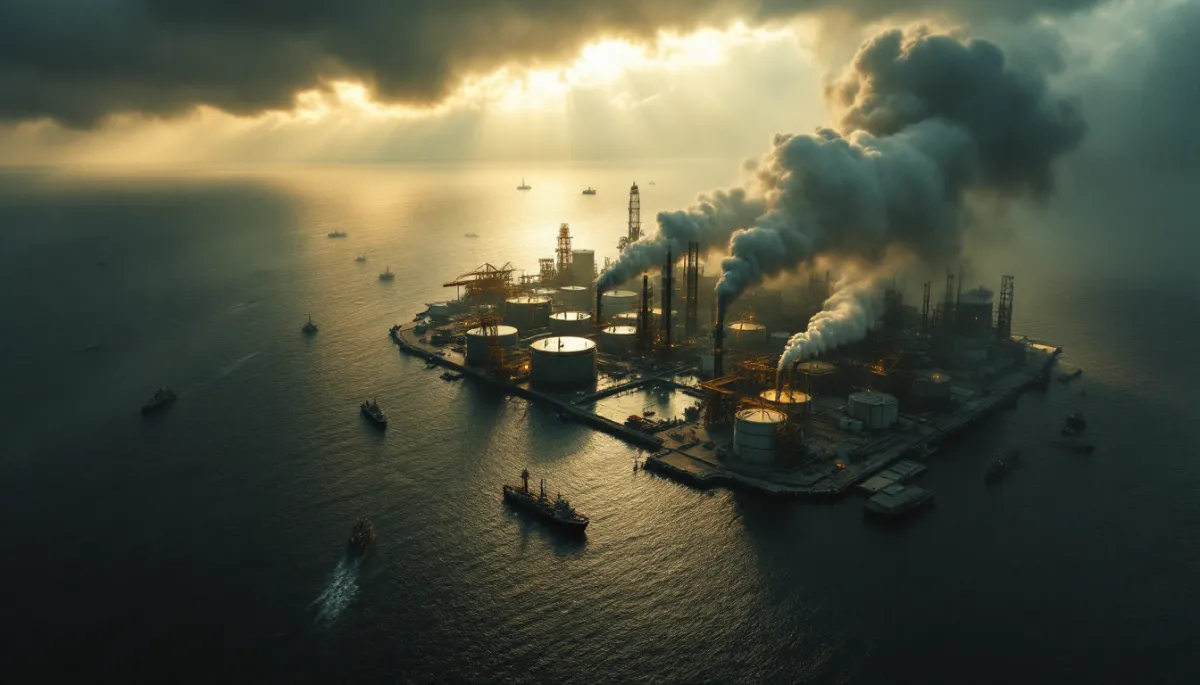
Kharg Island: The Oil Chokepoint You've Never Heard of That Controls Your Cost of Living
Ninety percent of Iran's crude oil exports flow through a single facility on a small island in the Persian Gulf. On April 7, the US military struck more than 50 targets on that island. They hit naval mine storage, missile bunkers, and military installations. They did not hit oil handling equipment. The distinction matters, because the next strike might not make it. If Kharg Island's oil infrastructure is damaged, the gap between Brent crude at $111 and Goldman Sachs' $147+ scenario closes fast. For expats across Southeast Asia and the Gulf, this is not an abstract geopolitical story. It is the single biggest variable determining your grocery bill, your fuel cost, your employer's margins, and the real return on your portfolio over the next six months.
Key Takeaways
- Kharg Island handles 90% of Iran's crude exports, and the US struck 50+ military targets there on April 7, deliberately avoiding oil infrastructure but establishing the capability to hit it.
- If oil infrastructure is targeted in a follow-up strike, Brent crude could gap from $111 toward $147 or higher, based on Goldman Sachs' analysis of a full Hormuz closure scenario.
- Net oil importers in Southeast Asia, including Thailand, the Philippines, and Singapore, would face immediate cost-of-living increases in fuel, food, and transport.
- Expats in the Gulf face the most concentrated risk: their income, their employer's business, and regional security are all tied to the same commodity and the same geography.
What Is Kharg Island and Why Does It Matter?
Kharg Island is a 20-square-kilometre island in the northern Persian Gulf, approximately 25 kilometres off Iran's coast, that serves as Iran's primary oil export terminal. Roughly 90% of Iran's crude oil shipments are loaded at Kharg. The island's infrastructure includes storage tanks with capacity exceeding 20 million barrels, multiple loading jetties, and pipeline connections to Iran's major onshore oil fields.
Before the current conflict, Iran was exporting approximately 1.5-1.8 million barrels per day, the majority through Kharg. That volume, while smaller than Saudi Arabia or the UAE, is large enough that its sudden removal from global supply would tighten markets immediately. The oil market operates on thin margins between supply and demand. Removing 1.5 million barrels per day from a market already stressed by Hormuz disruption would not create a gradual price increase. It would create a gap.
For expats who have been watching oil prices climb steadily over the past month, the distinction between $111 Brent and a potential $147+ Brent is the Kharg Island question. Everything between those two numbers depends on whether oil infrastructure is hit or spared.
How Does a Kharg Island Strike Change the Oil Price Picture?
The current $111 Brent price includes a geopolitical risk premium that Goldman Sachs estimated at $14-18 per barrel, but that estimate assumed military operations would avoid oil infrastructure. The April 7 strikes demonstrated that the US can hit Kharg with precision. The next question is whether it will.
What Is the Worst-Case Scenario?
Goldman Sachs has stated that Brent could exceed its 2008 all-time high of $147 if the Strait of Hormuz remains closed and Iranian oil infrastructure is targeted. At $147, the inflationary impact across Southeast Asia would be severe. Thailand, which imports nearly all of its crude, would face fuel price increases of 30-40% from current levels. The Philippines would see similar pressure. Even Malaysia, a net exporter, would face downstream inflation in refined products and imported goods.
What Is the Base Case?
If the US continues to avoid oil infrastructure and a diplomatic resolution or ceasefire extension emerges, Brent likely stays in the $105-115 range. This is elevated but manageable. The problem is that the base case requires restraint from an administration that has explicitly threatened to destroy Iran's civilian infrastructure if its demands are not met by 8 PM ET on April 8.
What Does This Mean for Expat Costs Across Southeast Asia?
Every dollar added to Brent crude flows through to consumer prices in net-importing countries within 4-8 weeks. The transmission mechanism is direct: crude oil prices drive refined fuel costs, which drive transport costs, which drive food and goods prices. There is no buffer in the chain for most Southeast Asian economies.
Thailand and the Philippines
Both countries import the vast majority of their crude oil. Thailand's baht is already under pressure from elevated energy costs. A move from $111 to $147 Brent would add approximately 15-20% to fuel costs at the pump, with food and transport following within weeks. For a European expat in Bangkok spending THB 150,000 per month, the energy-driven inflation component could add THB 15,000-20,000 to monthly costs by mid-year.
Singapore
Singapore imports all of its energy. LNG prices are already elevated from the EU ban on Russian LNG taking effect on April 25. A Kharg strike would compound the energy cost picture. Electricity tariffs, which are reviewed quarterly, would reflect the higher input costs in the next adjustment cycle. The SGD's strength provides some insulation, but not enough to offset a $36 per barrel crude spike.
Malaysia
As a net oil exporter, Malaysia benefits from higher crude prices at the government revenue level. But expats living in KL do not buy government revenue. They buy petrol, food, and services. Malaysia subsidises fuel, but the subsidy budget has limits. A sustained move above $130 Brent would pressure Petronas margins and potentially force subsidy adjustments that have so far been avoided.
How Should Expats Think About Portfolio Exposure to Oil Risk?
Most expat portfolios have indirect oil exposure that is larger than the allocation breakdown suggests. If you hold a global equity fund, you hold oil and gas companies. If you hold Asian equities, you hold companies whose margins are compressed by energy costs. If you hold bonds in net-importing countries, the inflation risk premium is rising.
The direct question is whether your portfolio benefits or suffers from a Kharg Island strike. For most expats in Southeast Asia, the answer is that it suffers, because the cost-of-living increase and employer margin compression outweigh any gains from energy equity exposure.
Gold at $4,667 per ounce continues to serve as the primary non-correlated diversifier in this environment. A Kharg strike would likely push gold higher as the geopolitical bid re-intensifies. Short-duration fixed income still yields attractively at the current Fed funds rate of 3.50-3.75%, and the cash positioning argument strengthens if inflation expectations rise.
What Does This Mean for Gulf-Based Expats Specifically?
Gulf-based expats face the most concentrated version of this risk: their employment, their income, their personal safety, and their cost of living are all tied to the same geography and the same commodity. An oil and gas executive in Abu Dhabi whose income depends on energy sector activity, whose employer's share price tracks crude, and whose family lives within missile range of an active conflict has correlated risk that no portfolio diversification can offset.
The UAE security environment has changed materially since the conflict began. Iran's IRGC has threatened retaliatory strikes "outside the region" on US and allied energy infrastructure. Whether or not those threats materialise, the insurance and risk calculus for families in the Gulf has shifted. If Kharg is struck and Iran retaliates against Gulf infrastructure, the employment risk conversation becomes a relocation conversation.
The financial planning implication is straightforward: do not build a 20-year plan on the assumption that your Gulf income continues uninterrupted. Maintain liquid reserves outside the region. Ensure your emergency fund is denominated in a currency that holds up during a regional crisis. Review your employment contract's severance and relocation provisions.
Frequently Asked Questions
Q: How likely is it that the US strikes oil infrastructure on Kharg Island?
A: The April 7 strikes demonstrated capability and willingness to target Kharg, while deliberately sparing oil assets. Trump's 8 PM ET deadline on April 8 is the inflection point. If Iran does not reopen Hormuz, the administration has explicitly stated it will escalate to civilian infrastructure. The probability is not zero, and the market is not fully pricing it in.
Q: What would happen to oil prices if Kharg Island's oil infrastructure is destroyed?
A: Removing 90% of Iran's export capacity, approximately 1.5-1.8 million barrels per day, from a market already stressed by Hormuz closure would likely push Brent above $130 rapidly. Goldman Sachs' $147+ estimate is the floor in a worst-case scenario, not the ceiling. Portfolio stress-testing should account for these levels.
Q: How does this affect my cost of living in Kuala Lumpur?
A: Malaysia subsidises fuel, which provides a buffer. But a sustained move above $130 Brent would pressure the subsidy system. Food and imported goods prices would rise regardless of fuel subsidies, as transport and supply chain costs increase. Budget an additional 10-15% for monthly expenses if oil stays above $130 for more than two months.
Q: Should I reduce my equity exposure because of Kharg Island risk?
A: Reducing equity exposure as a reaction to a single geopolitical event is rarely the right move. The better approach is to ensure your allocation is genuinely diversified across asset class, geography, and currency, and that your time horizon is long enough to absorb short-term volatility. If it is not, the problem predates Kharg Island.
Q: What is the best hedge against an oil price spike for expats?
A: Gold and short-duration fixed income are the most accessible hedges. Gold tends to rise during geopolitical escalation, and short-duration bonds provide yield without the interest rate risk of longer maturities. Energy equity exposure provides a direct hedge but introduces sector concentration risk. The most effective hedge is structural: a well-diversified portfolio with adequate cash reserves in a stable currency.
Q: How long would the oil price impact last if Kharg is struck?
A: Rebuilding oil export infrastructure takes months to years, not weeks. If Kharg's loading jetties and storage tanks are significantly damaged, the supply reduction would persist well beyond any ceasefire. The EIA's forecast of Brent falling to $70-80 by year-end assumes no major infrastructure damage. That assumption may not hold.
Related Reading
- How petrol prices from the Middle East conflict hit expats across Southeast Asia
- The double shock: when oil and tariff crises converge on the same day
- Why diversification means more than holding many things
- The expat's guide to capturing value during market dips
One island, one set of loading jetties, one pipeline network. Ninety percent of a country's oil exports. The US has already demonstrated it can reach it. The question now is whether it will, and whether your financial structure can absorb the answer.
Book a no-obligation call with Ciprian
This content is for informational purposes only and does not constitute personalised financial, investment, or tax advice. By reading this post, you agree to our disclaimer.