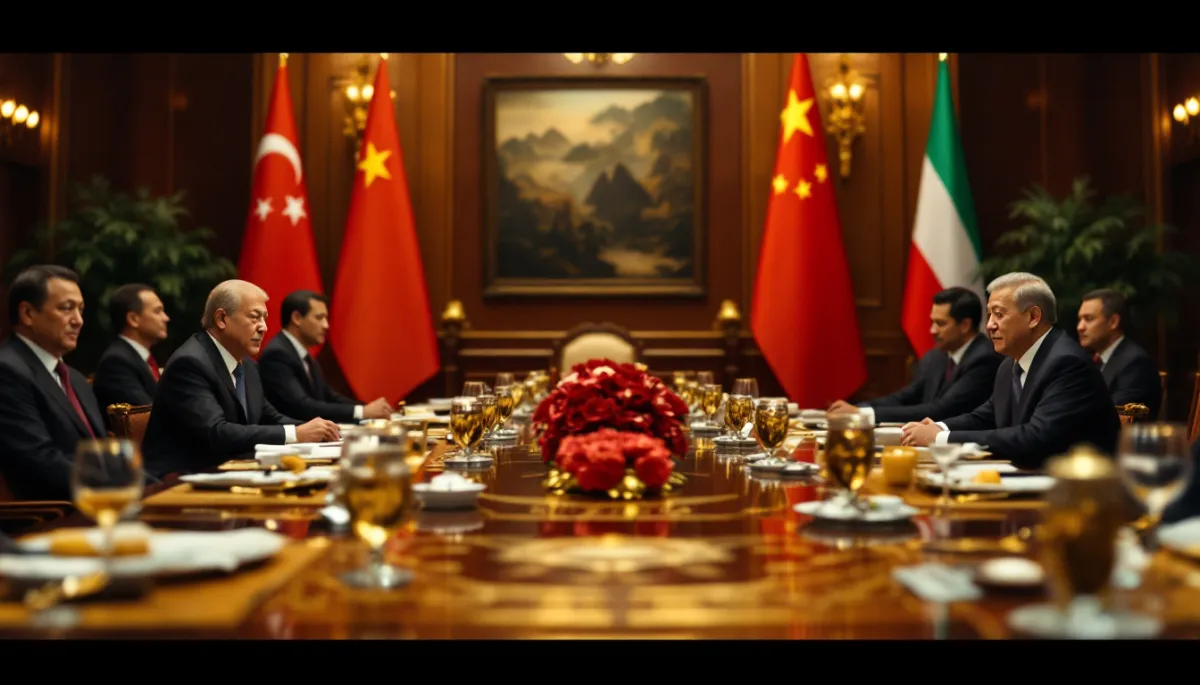
Trump-Xi Summit 2026: Implications for Expat Portfolios in Asia
The Trump-Xi summit opened in Beijing on May 14, 2026, the first US presidential state visit to China since 2017. The agenda carries three concurrent threads: a managed trade mechanism designed to reduce tariffs on approximately $30 billion in non-sensitive goods from each side, a parallel Board of Investment framework, and an explicit US request that Xi use China's economic relationship with Iran to push for a Strait of Hormuz reopening. Brent crude sits at $107, the US-Iran ceasefire is on "massive life support," and the IRGC has hardlined against concessions. For European expats in Southeast Asia with equity exposure across Asian markets, a currency position in MYR or SGD, and cost-of-living exposure to oil-sensitive prices, the Beijing summit is not a geopolitical abstraction. It is the most consequential market event of Q2 2026, and its outcome will reshape the risk environment for the next several months.
Last updated: 14 May 2026
Key Takeaways
- A positive Trump-Xi communiqué covering the managed trade mechanism and any Chinese commitment on Iran-Hormuz would be the largest risk-on catalyst of 2026, repricing Asian equities, EM currencies, and oil-sensitive assets materially upward.
- A summit that produces a trade deal with no Iran commitment leaves the Hormuz conflict premium intact, oil above $100, and stagflationary pressure continuing across Southeast Asia.
- Expat investors with diversified, globally positioned portfolios are better placed to absorb either outcome than those concentrated in single markets or asset classes.
- The correct response to binary event risk at this scale is to review portfolio structure in advance, not to trade around the summit itself.
What Is the Trump-Xi Beijing Summit and Why Does It Matter for Markets?
The Trump-Xi summit on May 14-15, 2026 is the first US presidential state visit to China since 2017 and the most consequential diplomatic event of H1 2026, with three concurrent issues on the table: a managed trade mechanism, a cross-border investment framework, and the United States' explicit request that China help reopen the Strait of Hormuz.
The managed trade element centres on what the US Trade Representative has called a "Board of Trade" mechanism. Under this framework, both sides identify approximately $30 billion in non-sensitive goods from each country on which tariffs could be reduced without crossing national security red lines. A parallel "Board of Investment" is also under discussion. These are not full tariff rollbacks. They are targeted reductions in areas of mutual economic interest, designed to create positive momentum without compromising either side's strategic sectors.
The Hormuz thread is the one that matters more for markets. Brent crude at $107 reflects a sustained conflict premium from the ongoing Iran-US ceasefire breakdown. Approximately 20,000 seafarers remain stranded on some 2,000 vessels unable to transit the strait. Trump has explicitly asked Xi to use China's economic relationships with Tehran to push for a Hormuz reopening. China purchases a significant proportion of Iranian oil under sanctions-avoidance arrangements. Its economic influence over Iran is real. Whether Xi commits to using it is the single most consequential undisclosed variable in current markets, as the IMF's latest global economic assessment has noted in flagging oil supply risk as the primary uncertainty in its 2026 projections.
What Would a Successful Communique Mean for Asian Equity Exposure?
A positive summit communiqué covering the trade mechanism and containing any language on China's Iran role would trigger a meaningful risk-on rally in Asian equities, EM currencies, and oil-sensitive assets, representing the most significant positive market event of 2026.
Asian equity markets have been pricing sustained uncertainty. The Hormuz conflict premium on oil has suppressed consumer discretionary and airline stocks across the region. Stagflationary pressure from $107 Brent has weighed on growth expectations for oil-importing economies in Thailand and Indonesia. A de-escalation catalyst, particularly one where Chinese diplomatic engagement accelerates a Hormuz reopening, would remove the oil premium, potentially pushing Brent toward $85-90, and simultaneously signal an improvement in US-China trade dynamics that supports regional manufacturing supply chains.
For expat investors with exposure to Asian equity funds, this scenario is bullish in the near term. MYR would strengthen as risk appetite improves. SGD would hold or marginally appreciate. Thai assets would reprice sharply upward on the oil relief. As the Financial Times has tracked throughout the summit preparation period, markets have been holding back from fully pricing the positive scenario, creating asymmetric upside if a substantive communiqué is published.
The Board of Trade Mechanism Explained
The "Board of Trade" concept was proposed by USTR Greer in March 2026 as a way to create managed tariff reduction without conceding the principle of strategic trade restrictions. The mechanism identifies categories of goods where economic interdependence is high and national security exposure is low, and negotiates bilateral tariff reductions in those categories. For the US, this might include agricultural products, consumer goods, and certain industrial components. For China, it could include electronics, processed materials, and commodity inputs.
$30 billion in tariff-affected goods from each side is a fraction of total US-China bilateral trade. But the signal matters. A working Board of Trade mechanism demonstrates that the two largest economies can manage disagreement in strategic sectors while maintaining commercial cooperation in others. That signal re-rates risk appetite for Asia-exposed portfolios.
What a Positive Communique Triggers for Expat Portfolios
For an expat investor in Malaysia holding a globally diversified UCITS portfolio with Asian equity exposure, a positive communiqué creates two near-term dynamics: a portfolio re-rating on the Asian equity component, and an MYR appreciation that increases the local currency value of any GBP or EUR income being received or remitted. Both are positive in the short term. The discipline required is to avoid chasing the rally by increasing concentration. A single-event catalyst does not constitute a structural change. The underlying risks, including Warsh's hawkish Fed posture and the unresolved Iran military situation, remain present regardless of how Beijing concludes.
How Does the Iran-Hormuz Link Change the Portfolio Risk Calculus?
The Hormuz thread is the most consequential and most opaque variable at the summit. A Chinese commitment to apply economic pressure on Iran, even implicit, would be the single biggest de-escalation catalyst of 2026. The absence of such a commitment maintains the stagflationary status quo.
The ceasefire between the US and Iran is described as on "massive life support." Iran rejected the US demand for upfront nuclear concessions. The IRGC has publicly pushed for escalation. Iran seized a tanker in the Gulf of Oman on May 8. Any further escalation, a vessel sinking, a US Navy engagement, or an IRGC-initiated incident, sends oil toward $120+ and triggers a global inflation shock that directly hits expat cost of living across Thailand, Indonesia, and the Philippines.
For expats in Malaysia, the position is more nuanced. Malaysia's oil exporter status means a higher oil price is partially positive for the ringgit and government revenues. But even Malaysia is not immune to secondary effects: jet fuel prices, imported food costs, and the global supply chain disruptions that follow a sustained Hormuz blockade all affect cost of living in KL. The direct expat cost-of-living impact of the Hormuz conflict premium has been covered in how petrol prices in Southeast Asia are driven by Middle East conflict.
What Happens to Expat Portfolios If the Summit Fails to Deliver?
A summit that produces only a trade mechanism with no Iran commitment, or no substantive communiqué at all, maintains the current stagflationary pressure: oil above $100, a hawkish Fed, EM currency weakness, and elevated cost-of-living across Southeast Asia.
The failure scenario does not create an immediate portfolio crisis for a well-structured expat investor. Markets have been pricing the Hormuz premium for weeks. The status quo of oil above $100 with a hawkish Fed is already the base case. A failed summit does not add new risk; it confirms the existing risk environment for longer.
What it does affect is timing. Expats who were expecting a Hormuz resolution to create a rate cut window in H2 2026 should plan for that window to be later than anticipated. The Fed will not cut into elevated oil-driven inflation regardless of who chairs it. A failed summit extends the high-oil, high-dollar, high-EM-pressure environment by a quarter or more.
For portfolio positioning, the failure scenario reinforces the argument for holding diversified UCITS structures rather than concentrated EM or oil-sensitive positions. The World Bank's East Asia Pacific economic overview projects that oil above $100 sustained through 2026 would trim 0.5-1.0 percentage points from growth in net oil-importing Southeast Asian economies. That is a meaningful headwind for local equity markets but an event that a diversified global portfolio absorbs without structural damage. Why diversification is the foundation of a resilient expat portfolio explains why the structure matters more than the event outcome.
How Should Expat Investors Position Around This Event?
The correct response to a high-stakes binary market event is to hold a well-structured, diversified position and review currency timing where relevant, not to trade around the outcome itself.
Binary events like the Trump-Xi summit create the illusion of tradeable scenarios. In practice, the market's first move after a major political announcement is frequently wrong, then reverses, then settles at a new equilibrium over 2-4 weeks. An expat investor who has already built a diversified portfolio does not need to act on the summit. The portfolio absorbs the scenario rather than betting on it.
The Case for Staying Invested Regardless of Summit Outcome
The argument for long-term equity investment through binary event risk is supported by decades of market data. As covered in 31 years of S&P 500 returns: a lesson in long-term investing, the cost of being out of markets during the 10 best trading days in any decade materially reduces long-term returns. Political events, including summit failures and diplomatic breakthroughs, are among the most frequent drivers of those best-day moves. An investor who exits before a summit to avoid downside often misses the upside recovery.
The expat-specific version of this principle is that currency moves around political events add a second layer of uncertainty. An expat in MYR who sells Asian equity exposure to hold MYR cash in anticipation of a summit failure takes on MYR-versus-home-currency risk on top of equity market risk. The hard truth about market returns: you cannot time it but you can prepare for it applies directly.
Reviewing Currency Exposure Before the Summit Outcome
What is actionable before the summit outcome is not trading equity positions. What is actionable is reviewing currency exposures. If you have a GBP pension transfer pending, a large MYR conversion planned, or a home-currency remittance scheduled, the summit outcome will affect the rate you receive. GBP/MYR at 5.31 and USD/MYR at 3.9266 today could move 3-5% in either direction within days of a communiqué. That is not a reason to delay the transaction indefinitely, but it is a reason to be deliberate about timing in the week of the announcement. For systematic currency management that removes event-timing anxiety, see how busy expats can turn currency swings into savings.
Frequently Asked Questions
Q: What is the "Board of Trade" mechanism being discussed at the Trump-Xi summit?
A: The Board of Trade is a managed tariff reduction framework proposed by USTR Greer in March 2026. Both sides identify approximately $30 billion in non-sensitive goods on which tariffs could be reduced without compromising national security restrictions. It is a targeted, category-specific reduction rather than a broad trade reset, designed to create commercial momentum while preserving strategic tariff authority on both sides.
Q: Why does a Strait of Hormuz reopening matter for expat investors?
A: The Hormuz conflict premium is currently adding approximately $15-20/barrel to Brent crude's price. A reopening and credible ceasefire would push Brent toward $85-90, reducing inflation across oil-importing economies in Southeast Asia, easing pressure on EM central banks, and creating conditions for a rate cut cycle that benefits EM equities and bonds. For expats, it also directly reduces cost-of-living through lower fuel, food transport, and airfare costs.
Q: Should I change my portfolio before the summit outcome is known?
A: For long-term holdings, no. Binary political events are poor timing signals for portfolio repositioning. The correct posture is to hold a well-diversified structure through the event. For currency transactions specifically, being aware of the summit timing and the potential for 3-5% exchange rate moves in the announcement period is reasonable planning, not speculation.
Q: What happens to the Malaysian ringgit if the summit succeeds?
A: A positive communiqué would likely strengthen MYR through two channels: a general EM risk-on rally that brings capital back to Southeast Asia, and a potential drop in Brent crude. The net MYR effect depends on the balance between risk-on flows and the oil revenue component. The consensus view is that a successful summit is net-positive for MYR on balance.
Q: What if the summit produces a trade deal but no Iran commitment?
A: A trade deal without an Iran commitment would be mildly risk-on for Asian equity markets but would leave the Hormuz premium intact. Oil would stay above $100. EM currencies would receive a modest boost from trade optimism but would not fully recover. For expats, cost-of-living pressure from oil-linked prices would continue. See why S&P 500 volatility creates a real opportunity for expat investors for context on positioning through partial resolutions.
Q: How does the Trump-Xi summit connect to the Fed's rate path?
A: Oil is the link. A Hormuz reopening that pushes Brent to $85-90 removes a significant component of the inflation keeping the Fed on hold. Core PCE at 3.2% today includes a meaningful oil-driven element. If oil falls materially, the inflation picture improves, and a rate cut cycle becomes possible in H2 2026 even under a hawkish Warsh. A failed summit that keeps oil above $100 keeps the Fed on hold through year-end and beyond.
Related Reading
- Why diversification is the foundation of a resilient expat portfolio
- Market volatility: the expat's hidden retirement advantage
- The hard truth about market returns: you cannot time it, but you can prepare
- How to stop playing defence with your money and build proactively
If the summit's outcome changes your risk environment materially, a portfolio review is the right next step. A review identifies what you hold, what it is exposed to, and whether the current structure serves your goals regardless of how the Beijing communique reads.
Book a no-obligation call with Ciprian
This content is for informational purposes only and does not constitute personalised financial, investment, or tax advice. By reading this post, you agree to our disclaimer.