China Responds to Balikatan 2026: What PLA Naval Drills Near Taiwan Mean for Expat Portfolios in Asia
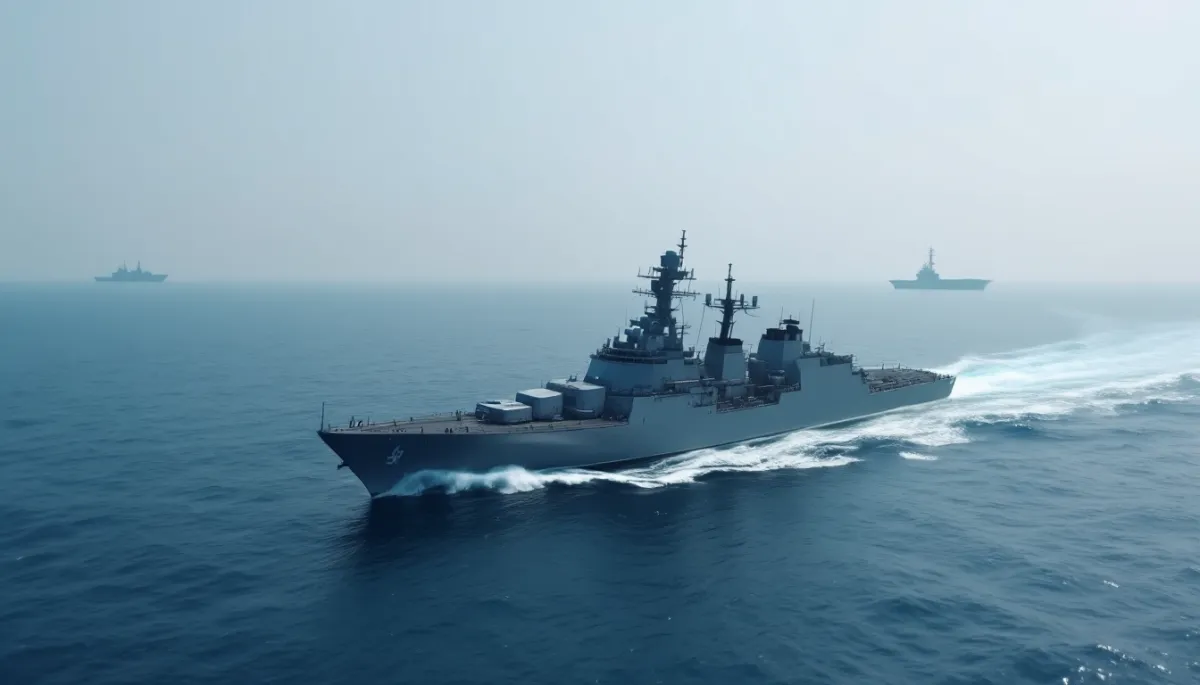
China's PLA Southern Theatre Command launched naval exercises east of a Philippine island near Taiwan on May 5 — timed directly to coincide with Balikatan 2026, the 19-day joint military exercise led by the US and Philippines with unprecedented Japanese participation. The drill is led by the Type 055 destroyer Zunyi. Beijing called the exercises a "necessary response to the current regional situation."
This is not news in isolation. PLA exercises in response to US military activity in the region are routine. What is not routine is the density of simultaneous military operations across the Indo-Pacific in the first week of May 2026: US naval combat in Hormuz, Iran striking UAE targets, PLA exercises near Taiwan, and a US-Philippines-Japan joint operation running concurrently. For expats with Singapore-listed equities, Asia-Pacific equity exposure, or employers with significant China-facing revenue, the tail-risk environment has changed.
Last updated: 5 May 2026
Key Takeaways
- China launched PLA naval exercises near Taiwan in direct response to Balikatan 2026 — a US-Philippines-Japan joint exercise with unprecedented Japanese participation — using the Type 055 destroyer Zunyi.
- The density of simultaneous military operations across the Indo-Pacific in May 2026 is historically unusual and adds tail-risk premium to Asian equities, independent of any specific escalation.
- Singapore-listed companies with China or Taiwan exposure are the most directly affected holdings for expats in Southeast Asia.
- No immediate market spike is expected, but the compounding of Hormuz, Taiwan Strait, and South China Sea tensions in the same period creates a different risk environment than any single crisis in isolation.
What Is Balikatan 2026 and Why Did China Respond?
Balikatan 2026 is a 19-day joint military exercise between the United States, the Philippines, and Japan — with Japan's participation at its highest level ever in this exercise format. The inclusion of Japan is the specific element that triggered the PLA response. From Beijing's perspective, a trilateral exercise involving Japan operating from Philippine territory, close to Taiwan and the South China Sea, signals a qualitative shift in the US alliance architecture in the region.
The PLA Southern Theatre Command's response is calibrated: exercises east of a Philippine island near Taiwan, using the Type 055 (Renhai-class cruiser, China's most capable surface combatant) as the flagship. This is a message exercise, not a combat deployment.
Why the Type 055 Specifically?
The Type 055 Zunyi is not selected at random. It is China's most capable surface combatant — the equivalent of a US Ticonderoga-class cruiser in terms of the signal it sends. Using it as the lead vessel of exercises near Taiwan communicates PLA capability, not just political intent. This is the vessel China would deploy in a Taiwan contingency.
The exercise is being watched by Singapore, Malaysia, and Japan's defense establishments closely. Any incident involving a Type 055 in these waters would not stay local.
How Does Taiwan Strait Risk Actually Affect Expat Portfolios?
Elevated Taiwan Strait risk adds a risk premium to Asian equities — particularly Singapore-listed companies with China operations, semiconductor exposure, or Taiwan-adjacent supply chains — without necessarily producing an immediate market correction. The premium is not a crash; it is a sustained discount to valuations that would otherwise be justified by fundamentals alone.
For expats in Southeast Asia holding direct Singapore Exchange (SGX) equities or Asian equity funds:
Semiconductor and electronics companies with Taiwan or China fab exposure carry the most concentrated risk. If you hold SGX-listed companies with significant operations in Taiwan's TSMC supply chain, or mainland Chinese manufacturers selling into Western markets, those holdings are structurally more exposed than their current prices reflect.
Diversified Asian equity UCITS — structured through Irish-domiciled funds — are somewhat buffered by their geographic spread, but they still carry Taiwan tail-risk proportional to their China-Asia Pacific allocation.
The Employer Exposure That Most Expats Don't Think About
The more direct risk for employed expats is what China-Taiwan tension means for their employer. Expats working for multinational companies in Malaysia and Singapore whose revenue is substantially Asia-Pacific-derived — technology, electronics, semiconductor equipment, financial services with APAC trading desks — are running employer risk alongside portfolio risk.
A serious Taiwan Strait escalation would not just move markets. It would affect hiring decisions, project pipelines, and operational continuity for the kinds of employers that hire senior European expats in the region.
Is This Risk Priced Into Asian Markets?
No — at least not fully. Asian equity markets have been pricing Hormuz risk, US tariff risk, and Singapore GDP contraction. The Taiwan Strait tail risk from the Balikatan response is a fourth risk layer that compounded in the same week, and markets tend to price risks sequentially, not simultaneously.
The practical implication: Asian equities are pricing in known risks on a one-at-a-time basis. A compound event — Hormuz and Taiwan simultaneously escalating — would not be additive in market terms. It would be multiplicative. That is what "tail risk" means in practice.
What Singapore's Unique Exposure Looks Like
Singapore's economy is a trade and financial intermediary for Asia-Pacific commerce. It does not manufacture at scale, but it finances, insures, and routes the trade flows between China, the rest of Asia, and Western markets. A Taiwan Strait crisis hits Singapore at multiple points simultaneously: trade finance slowdown, shipping route disruption (not just Hormuz but the whole Asia-Pacific arc), and equity market correction in SGX-listed names.
MAS tightened the SGD NEER band in April to fight imported inflation. A Taiwan escalation event would create an opposite MAS dilemma: capital flight and currency pressure on one side, growth slowdown on the other. The policy toolkit gets harder to use, not easier.
What Does This Mean for an Expat Portfolio Positioned for Hormuz Risk?
An expat portfolio correctly positioned for Hormuz risk — with reduced cash duration, some commodity or real asset exposure, and a review of currency conversion timing — is partially but not fully positioned for a Taiwan escalation scenario. The overlaps: both scenarios support gold, both scenarios argue against overconcentration in Asia-Pacific equities, both scenarios make the case for portfolio structures that do not depend on continuous free trade in the region.
The differences: Taiwan escalation hits the USD differently from Hormuz. A Taiwan crisis produces a flight-to-USD that strengthens the dollar and weakens MYR. Hormuz has been MYR-positive (Malaysia's oil exports). A compounded scenario would produce currency volatility that neither analysis alone captures.
This is the argument for portfolio architecture over portfolio trading: a well-structured portfolio across asset class, geography, and currency — held through Irish UCITS — navigates regime changes better than a portfolio optimised for any single scenario.
How the Hormuz crisis has already changed the risk framework for expat portfolios and the case for diversification that covers jurisdictions, not just asset classes.
Frequently Asked Questions
Q: Is a PLA exercise near Taiwan the same as China actually threatening to invade?
No. PLA exercises in response to US military activity are routine. The signal value here is the choice of vessel (Type 055) and the timing (directly concurrent with Balikatan 2026). Markets read this as calibrated deterrence, not imminent action. The tail risk is not that this exercise ends in conflict — it is that the next one, or the one after, occurs in a higher-tension environment.
Q: Should I sell Singapore-listed equities because of this?
Selling every Asian equity holding every time PLA exercises occur would produce negative returns over any 3–5 year horizon. The question is whether your SGX exposure is concentrated in sectors directly linked to Taiwan supply chains or China revenue. If it is, a review is warranted — not a panic sale, but a structural reassessment of concentration risk.
Q: How does this interact with the Hormuz crisis for portfolio positioning?
The two crises have different currency implications. Hormuz is broadly positive for MYR (Malaysia is an oil exporter). A Taiwan escalation would produce dollar strength and MYR pressure. An expat portfolio that ignores the Taiwan tail risk because Hormuz is the dominant story is running a different exposure than it thinks. Why this market volatility is different from previous cycles covers the compounding dynamic.
Q: What is Japan's expanded role in Balikatan, and why does it matter?
Japan participating in Balikatan at an unprecedented level signals that the US alliance architecture in the Pacific is actively expanding its operational footprint. Japan's Self-Defense Forces exercising with US and Philippine forces from Philippine territory is a significant step beyond previous exercises. Beijing interprets this as preparation for a Taiwan contingency, not just a Philippines defence exercise.
Q: Are UCITS funds exposed to Taiwan risk?
Irish-domiciled accumulating UCITS that hold Asia-Pacific equities will have Taiwan and China exposure proportional to their index weighting. Global equity UCITS will have less direct exposure. The structural advantage of Irish UCITS is jurisdictional — they sit outside the US estate tax framework and provide tax efficiency regardless of what happens to any specific regional market. Why Irish UCITS are the default structure for internationally mobile expats.
Q: What would a serious Taiwan escalation do to the SGD?
A serious escalation — beyond exercises into an actual Taiwan Strait confrontation — would produce capital outflows from Asian markets including Singapore, pressuring SGD despite MAS management. MAS's tools are more effective against inflation than against capital flight. The SGD is structurally resilient but not immune to a regional shock of that magnitude.
Related Reading
- China Defied the Hormuz Blockade: The Second-Front Risk for Expat Portfolios
- Think You're Diversified? A Guide for High-Income Expats
- Trump-Xi Summit May 14: How to Position an Expat Portfolio for the Trade Binary
- Mid-May 2026: The Highest-Risk Period for Expat Portfolios
The question for an expat portfolio in May 2026 is not whether any single event resolves. It is whether the structure of your holdings is built for a world where multiple simultaneous risk events can occur — and compound. That is the environment you are in now.
Book a no-obligation call with Ciprian
This content is for informational purposes only and does not constitute personalised financial, investment, or tax advice. By reading this post, you agree to our disclaimer.